


Hi there! How can we help you today?
ChatGPT vs Google: Why Your SEO Strategy Needs to Target Both in 2026?
Learn why businesses in 2026 need to optimize for both Google and AI platforms like ChatGPT. This blog explains how search behavior is changing, why AI visibility matters, and what SEO strategies can help your business stay discoverable across search engines and AI-generated answers.
The Way People Search Online Is Changing Fast
A few years ago, Google was the only tool people used to find information online.
You had a question . you Googled it. That was the entire process.But that is no longer the case.
Today, hundreds of millions of people are using AI tools like ChatGPT and Perplexity to get their answers. They are typing questions and getting direct responses without ever visiting Google.The numbers confirm this shift.
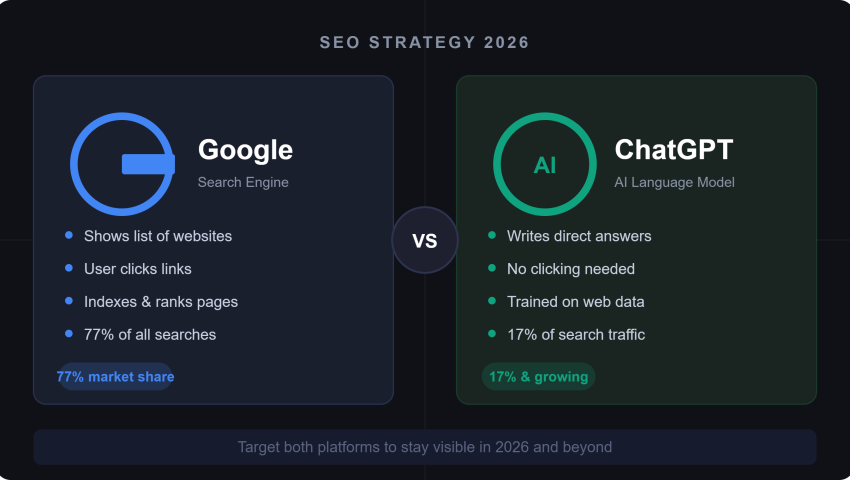
Google still handles around 77% of all online searches and remains the market leader.
However, ChatGPT alone now accounts for over 17% of search-style traffic as of early 2026.
That is not a small or temporary change. That is a major shift in user behavior.
The problem is that most businesses have not responded to this change.They are still focusing entirely on Google SEO. They are ignoring AI platforms completely. This means they are invisible to a large and growing segment of online users.
If your business is still optimizing only for Google, you are missing a significant opportunity.This article will show you exactly what has changed, why it matters, and what you should do about it.
Google and ChatGPT Are Not the Same Thing — But They're After the Same People
First, Let's Understand What Google Actually Is
Google is a search engine. Its job is to scan billions of websites on the internet and organize them.When you type something into Google, it shows you a list of websites ranked by relevance and trustworthiness. Google does not write answers for you, it points you to other websites that might have the answer. You then click a link and visit that website yourself.
Now, What Is ChatGPT?
ChatGPT is not a search engine. It is an AI tool built on a large language model. It was trained on a massive amount of text from books, websites, and other sources. When you ask ChatGPT a question, it does not show you a list of links.Instead, it reads your question and writes a direct answer for you — in plain language. You do not need to click anywhere. The answer comes straight to you.Increasingly, ChatGPT also pulls real-time information from the web to keep its answers current.
So What Is the Key Difference?
ChatGPT | ||
Type | Search Engine | AI Language Model |
What it does | Shows a list of websites | Writes a direct answer |
User action needed | Click a link to read | Read the answer immediately |
How it works | Indexes and ranks websites | Generates responses from training + web data |
But Here Is the Important Part — The User Goal Is the Same
Whether someone types a question into Google or ChatGPT, they want the same thing.
They want an answer, a recommendation, a service, or a solution to their problem.
For example — if someone types:
"Who is the best digital marketing agency in my city?"
Google will show a list of websites and directories.
ChatGPT will directly name a few businesses in its answer.
Those business names inside ChatGPT's answer come from reviews, directories, blog mentions, and content across the web.
If your business is not present in those sources — ChatGPT will not mention you.
Even if you rank perfectly on Google, you could still be completely invisible on ChatGPT.
That is the gap most businesses are missing right now.
What 'Ranking' Looks Like on an AI Platform
1.AI ranking is not fixed
One user may ask “best SEO company in Mohali,” another may ask “affordable SEO agency for local business.” AI answers can change based on query wording, location, freshness, and available sources.
2.Citation matters more than position
On AI platforms, visibility often means being mentioned, cited, or recommended inside the answer. Not just “ranking number one.”
3.Your website must be crawlable
Add a technical point about making sure important pages are not blocked by robots.txt, security plugins, or firewall rules. OpenAI says site owners can manage access separately for OAI-SearchBot and GPTBot, and OAI-SearchBot relates to appearing in search-style results.
4.Structured data helps, but it is not magic
Google says structured data helps it understand page content and entities better, but the content still needs to be genuinely useful and reliable.
5.AI visibility needs brand consistency
Same business name, same service descriptions, same location signals, same NAP details across website, GBP, directories, review sites, and social profiles.
The Real Problem: Zero-Click Searches Are Eating Your Traffic
The Real Problem: Zero-Click Searches Are Eating Your Traffic
First, Let's Understand What a Zero-Click Search Is
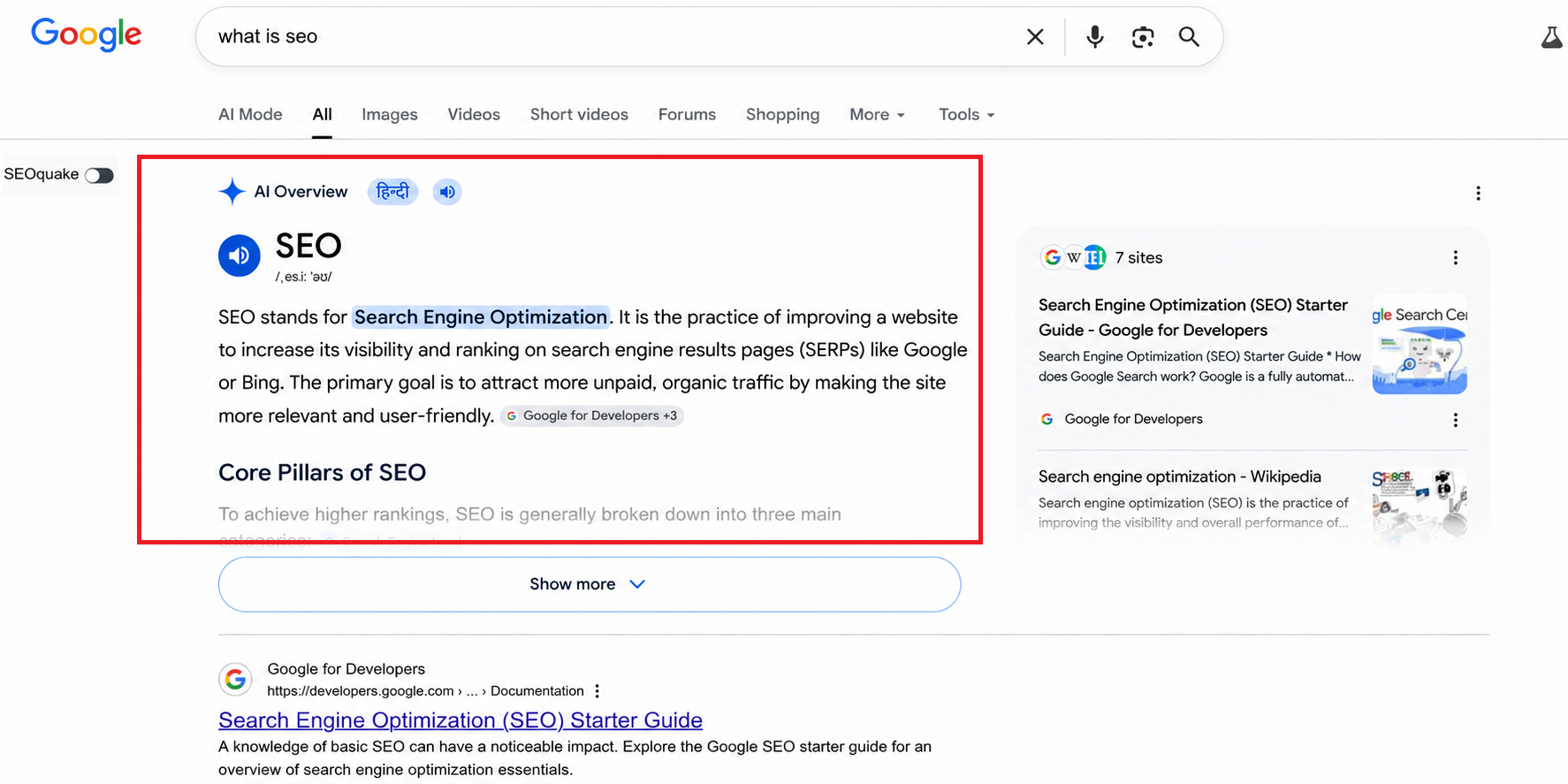
A zero-click search happens when a user types a question into Google and gets the answer directly on the search results page. They never click any website link. They read the answer and leave. Your website gets zero traffic even if you are ranking on page one.
This is now happening millions of times every single day.
What Is a Google AI Overview?
Google now places a large AI-generated answer box at the very top of search results. This box is called an AI Overview . It reads multiple websites, summarizes the information, and presents one combined answer to the user. The user reads it. Gets their answer. And moves on — without visiting any website.
Why Is This Getting Worse?
Step 1 — Google introduced AI Overviews in 2023 These answer boxes sit above all organic results — even above position number one.
Step 2 — Mobile usage increased the problem Most people now search on mobile phones where screen space is limited. The AI Overview takes up the entire screen — pushing all website links far below.
Step 3 — Users got used to instant answers People no longer expect to click links. They expect Google to hand them the answer immediately. This behavior is now a habit for most users.
Step 4 — Your traffic dropped without you realizing why Your keyword rankings stayed the same. But your website visits quietly decreased month by month. Most business owners blamed the algorithm but AI Overviews were the real reason.
What a Dual SEO Strategy Actually Looks Like in 2026
Let's get practical. Targeting both Google and AI platforms isn't about doing twice the work. A lot of the fundamentals overlap. It's more about adjusting your approach so you're covering both bases without burning out your team or blowing your budget.
1. Build Topical Authority, Not Just Individual Pages
Google and AI tools both reward depth. One random blog post about local SEO isn't going to do much. But a website that has 20 interconnected pieces of content covering local SEO from every angle — that gets treated as an authority source.
Build topic clusters. Write the cornerstone piece, then surround it with supporting content. Each page links to the others. Over time, both Google and AI tools start seeing your site as the go-to resource on that topic.
2. Get Mentioned Everywhere That Matters
AI models learn from the web. If your business is mentioned in local news articles, industry directories, guest posts, review platforms, and partner websites that builds what people in SEO are now calling 'entity authority.'
You're not just a website. You're a business that exists in the real world, with a reputation that's been confirmed by multiple independent sources. That's what AI tools use to decide whether you're worth recommending.
This is especially important for local businesses. The best local SEO company isn't just one that ranks on Google Maps it's one that's visible across every platform where local customers are looking.
3. Write Like You're Answering a Specific Question
AI tools are trained to match answers to questions. If your content is vague, generic, or written purely for keyword density, it won't get pulled into AI responses. Full stop.
Write content that directly answers real questions your customers ask. Use clear headings. Give specific answers. Don't bury the lead in fluff. The more your content reads like a direct, helpful response to a clear question, the more likely it is to get cited by Google's AI Overview or by ChatGPT.
4. Your Google Business Profile Still Matters — A Lot
Local SEO isn't dead. Not even close. AI tools cross-reference local directories and review platforms to confirm whether a business is legitimate. Your Google Business Profile with accurate information, real reviews, and regular updates, feeds directly into that.
If you've been neglecting your GBP, fix it. It's one of the highest-ROI things you can do for local visibility — whether someone's searching on Google, asking ChatGPT, or using Perplexity to find a service near them.
5. Structured Data Is Not Optional Anymore
Schema markup tells search engines and AI tools exactly what your content is about. Your business type, services, location, reviews, FAQs — all of it can be structured so machines understand it instantly.
Most businesses skip this because it sounds technical. But it's one of the clearest signals you can send to both Google and AI platforms. A proper search engine optimization specialist will build this into your site as a foundation, not an afterthought.
What Hasn't Changed (And Won't)
All this talk about AI can make it feel like everything you knew about SEO is dead. It's not.
Backlinks still matter. Quality content still wins. Page speed, mobile friendliness, Core Web Vitals — all still relevant. Google hasn't abandoned traditional ranking signals. They've layered AI on top of them.
What's changed is the additional layer. You now need content that satisfies both a human reader and a machine trying to understand whether you're a credible source worth surfacing. Those two things aren't at odds — they actually push you toward better content overall.
What to Actually Do This Month
Enough theory. Here's where to start:
• Audit your existing content — is it answering real questions clearly and specifically?
• Check your Google Business Profile — is it complete, accurate, and getting reviews?
• Look at your schema markup — is your site helping machines understand what you do?
• Find the gaps in your topic coverage — what questions do your customers ask that you haven't written about yet?
• Search your business name in ChatGPT — does it come up? If not, what would need to change?
None of this is complicated. But it does take consistent effort. And that's exactly why most businesses don't do it.
FAQ
Q: Is ChatGPT actually replacing Google for search?
Not replacing — but it's definitely competing. As of 2026, Google still holds around 77% of all digital search queries, but ChatGPT and similar AI tools have captured a meaningful and growing share. For certain types of queries, especially research-heavy or conversational ones, people are increasingly turning to AI first. Your strategy needs to account for both.
Q: How do I get my business mentioned in ChatGPT answers?
There's no direct submission process like there is with Google's index. Instead, focus on building authority signals that AI models pull from — reviews across multiple platforms, mentions on reputable websites, well-structured content that answers specific questions, and consistent brand presence across directories and social channels. Over time, this increases the likelihood of being cited.
Q: Does working with the best SEO marketing company help with AI visibility too?
A good one, yes. The best SEO marketing companies in 2026 aren't just thinking about Google rankings. They're building content strategies, authority signals, and structured data approaches that work across the entire search ecosystem — including AI tools. If your current agency is only talking about Google, that's worth asking about.
Q: What is a search engine optimization specialist doing differently in 2026?
A lot more than they were two or three years ago, honestly. Beyond traditional on-page SEO and link building, a modern search engine optimization specialist is thinking about entity authority, structured data, AI visibility, topic clusters, and zero-click optimization. It's become a much broader discipline. Which is also why experience matters more than ever.
Q: Is local SEO still worth investing in with AI search growing?
Absolutely. If anything, local SEO has gotten more valuable. AI tools actively use local directories, review platforms, and Google Business Profile data to answer 'near me' queries and local recommendations. The best local SEO company strategies now factor in both traditional local signals and the newer AI-driven local discovery patterns. Don't let anyone tell you local SEO is dead.
Q: How long does it take to see results from a dual SEO and AI strategy?
Traditional SEO timelines still apply — 3 to 6 months before you see meaningful organic movement. AI visibility takes similar time, maybe a bit longer, because it relies on cumulative authority signals rather than direct ranking factors. The key is starting now. Every month you wait is a month your competitors could be building that authority instead.
Q: Should I create different content for Google vs ChatGPT?
Not really. The same qualities that make content rank well on Google — clarity, depth, accuracy, structured answers to real questions — are the same qualities that make content get cited by AI tools. The main adjustment is making sure your content is more conversational and directly answers specific questions, rather than being purely keyword-optimized. One well-written piece of content can serve both.

Author
Web Winners
Leave a comment
Your email address will not be published. Required fields are marked *